Ważne pozarządowe terminy pod ręką Bezpłatny kalendarz ngo.pl na 2026 rok. Pobierz >

RISE - Engaged Research in the Social Economy
17 stycznia 2026, 09:30
17 stycznia 2026, 09:30 - 20 lutego 2026, 14:15
Bezpłatne
Program RISE wzmacnia potencjał organizacji ekonomii społecznej (organizacji charytatywnych, spółdzielni, grup społecznych i wolontariackich) w zakresie angażowania się w badania naukowe oraz kierowania nimi. To bezpłatne szkolenie pomaga kształtować badania i innowacje, uzyskiwać dostęp do finansowania oraz pewnie nawiązywać współpracę z naukowcami. Dzięki niemu zrozumiesz etapy badań zaangażowanych, kwestie etyczne, wykorzystanie danych, ścieżki finansowania oraz sposób włączania badań do strategii organizacji.
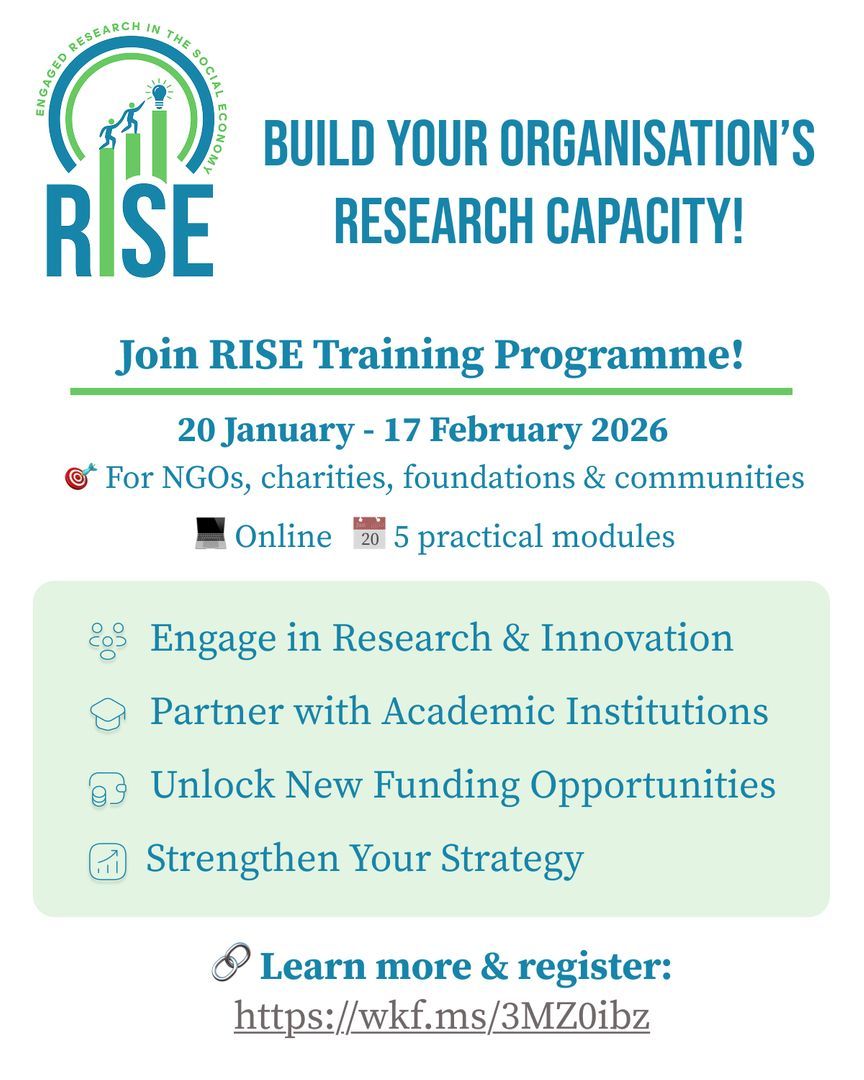
RISE training program from 20 january to 17th february. 5 modules for NGOs to get involved in research and proposals
RISE builds the capacity of social economy organisations (charities, co-ops, community and voluntary groups) to engage in and lead research. This free training helps you shape research and innovation, access funding, and partner confidently with academics. You will understand engaged research phases, ethics, data use, funding pathways, and how to embed research in organisational strategy.
Join the RISE training programme, an EU initiative aimed at enhancing organisational capacity in research and innovation. Take this opportunity to strengthen your skills, expand your network, and increase your organisation’s impact in collaborative projects.
What is RISE?
RISE is an initiative dedicated to building the capacity of social economy organisations such as charities, foundations, co-operatives, community, and voluntary groups to participate in and lead engaged research.
You can learn more about the project here: www.engaged-rise.eu
The training provides the necessary tools and skills to help your organisation:
- Strengthen your confidence in partnering with academic institutions.
- Access new streams of funding by being research-ready.
- Play a more active role in shaping research and innovation in your area.
By taking part in this free training program, you will:
- Advocate for the integration of research into organisational strategy.
- Identify appropriate funding channels and application procedures.
- Develop and manage basic data systems for project evaluation.
- Demonstrate confidence in interacting with academic partners.
- Recognise ethical considerations in engaged research.
- Describe the key phases and roles in an engaged research process.
Detailed description of the Modules:
Module 1 - Induction And a Deep Dive into Engaged Research
Introduces the principles and processes of engaged research (ER), highlighting key phases, roles, and differences from traditional research.
Learning outcomes: Understand ER, identify what makes research "engaged", recognise roles in the research process, and navigate challenges.
Module 2 - Ethics And Values in Engaged Research|
Focuses on ethical practice, values, and power dynamics within ER. Participants reflect on transparency, inclusivity, and responsible engagement.
Learning outcomes: Recognise ethical principles, identify power asymmetries, and apply ethical frameworks in practice.
Module 3 - Partnership Building, A Fundamental of Engaged Research
Develops skills for co-creating research questions and collaborating confidently with academic partners.
Learning outcomes: Understand partnership roles, build mutual trust, and strengthen collaborative development.
Module 4 - Data management, Impact Assessment, And Communicating Your Project
Covers data management, impact evaluation, and effective communication strategies. Participants learn to tailor their messages to different audiences using storytelling and evidence.
Learning outcomes: Manage project data, distinguish between outputs and impact, apply frameworks for evaluation, and communicate findings effectively.
Module 5 - Funding For Engaged Research Projects & Engaged Research Plan
Explores how to identify and apply for funding, and how to ensure project sustainability through strong partnerships and stakeholder engagement.
Learning outcomes: Develop grant writing skills, navigate EU and national funding, and plan for long-term impact.
Register now! 🔗 https://wkf.ms/3MZ0ibz
Pilot Programme Dates
The pilot training will run from 20 January to 17 February 2026. The course comprises five modules and will be delivered online.
Module 1: Induction And a Deep Dive into Engaged Research
Tuesday, 20 January 9:30 to 12:30
Zoom: https://eu01web.zoom.us/j/66672785428
Module 2: Ethics And Values in Engaged Research
Tuesday, 27 January 9:30 to 12:30
Zoom:https://eu01web.zoom.us/j/67895472484
Module 3: Partnership Building, A Fundamental of Engaged Research
Tuesday, 3 February 9:30 to 13:30
Zoom: https://eu01web.zoom.us/j/69572112844
Module 4: Data management, Impact Assessment, And Communicating Your Project
Tuesday, 10 February 9:30 to 14:15
Zoom:https://eu01web.zoom.us/j/67376632687
Module 5: Funding For Engaged Research Projects & Engaged Research Plan
Tuesday, 17 February 9:30 to 14:15
Zoom:https://eu01web.zoom.us/j/69741034848
- While recordings will be made available for your convenience, please note that attendance is mandatory for three of the modules to successfully complete the program.
Register here! 🔗 https://wkf.ms/3MZ0ibz
If you have any questions, please feel free to contact me at[email protected]
Best wishes,
Magdalena Schieferdecker & Nikita Sharma
Pliki do pobrania
Szczegóły wydarzenia
-
Rodzaj wydarzenia:Bezpłatne
-
Początek wydarzenia:17 stycznia 2026, 09:30
-
Zakończenie wydarzenia:20 lutego 2026, 14:15
-
-
Organizator:European Citizen Science Association (ECSA)
-
E-mail:Pokaż
-
Telefon:Pokaż
Redakcja portalu www.ngo.pl nie odpowiada za treść zaproszeń.
Przedruk, kopiowanie, skracanie, wykorzystanie tekstów (lub ich fragmentów) publikowanych w portalu www.ngo.pl w innych mediach lub w innych serwisach internetowych wymaga zgody Redakcji portalu.